






A firefighter who can consistently force a residential door may find that the same techniques produce very different results against a commercial steel door mounted in a metal frame.
The difference isn't necessarily the firefighter's strength or experience. Steel doors and metal frames behave differently under force, particularly when the frame is anchored into masonry or reinforced construction.
A wooden doorframe may split, separate, or deform as leverage is applied. A commercial steel frame may remain relatively rigid, leaving firefighters to overcome resistance from the locking hardware, door assembly, or securing devices.
That difference becomes significant when firefighters encounter the rear entrance of a commercial occupancy, a mechanical room, an industrial facility, or a secured stairwell.
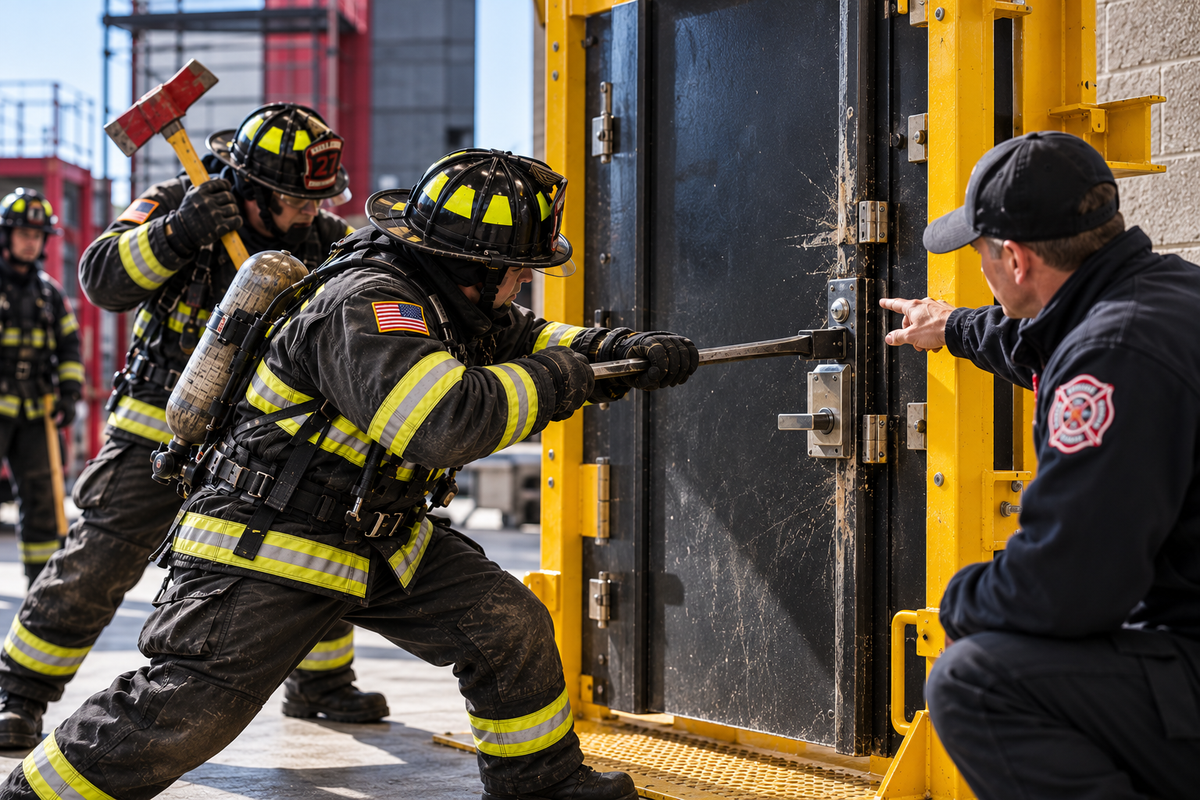
Training firefighters to force steel doors requires more than increasing the resistance on a door prop. It requires teaching them to recognize commercial door construction, understand how metal components respond to force, and adapt their techniques when the door doesn't behave as expected.
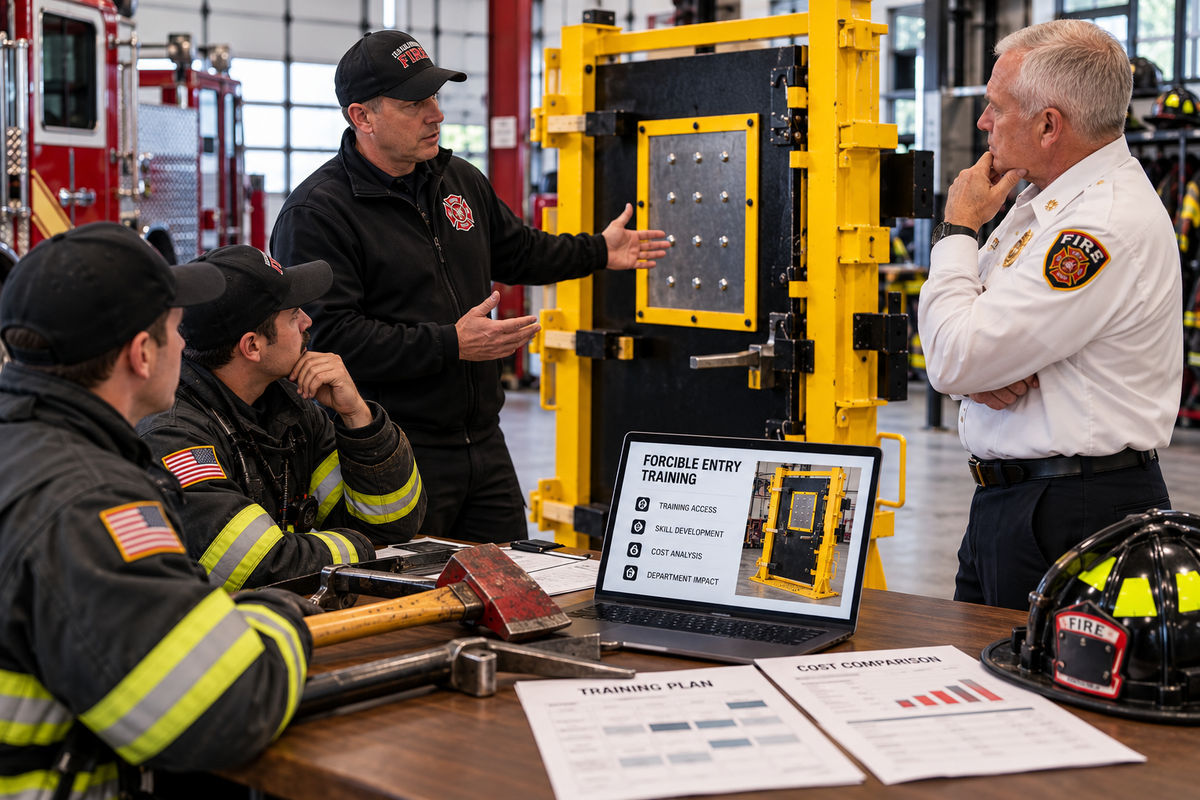
For training officers, the challenge is creating realistic opportunities to develop those skills without turning every evolution into a contest of brute strength.
Why Are Steel Doors More Difficult to Force Than Residential Doors?
Not every steel door is difficult to force, and not every wooden door is easy.
The actual resistance depends on the entire assembly: the door, frame, hardware, anchoring, and surrounding construction.
However, commercial steel door assemblies often present challenges that differ substantially from typical residential construction.
Consider a common residential entry door installed in a wood-framed wall.
When firefighters apply leverage, they may be able to deform the jamb, separate the doorstop, or create movement around the locking hardware. In some cases, the wooden frame begins failing before the lock itself does.
Now consider a hollow-metal commercial door installed in a steel frame anchored into a masonry wall.
The surrounding construction may provide considerably less movement. The frame may remain rigid while the door flexes or its locking hardware resists movement.
This changes how firefighters establish purchase, apply leverage, and recognize progress.
In Firehouse's discussion of forcible entry skills and training, instructors emphasize identifying the weakest component of a door assembly rather than assuming the same forcing approach will work against every type of construction.
That principle is particularly important when training for commercial steel doors.
The door isn't always the strongest component
A steel door may appear formidable while its frame, hardware, or surrounding construction presents a more vulnerable point.
Conversely, a relatively ordinary-looking steel door may be installed in a heavily reinforced frame with substantial locking hardware.
Firefighters need to evaluate the complete assembly rather than judge difficulty by the material visible on the door's surface.
Teach Firefighters to Recognize Different Steel Door Assemblies
Before firefighters can effectively train against steel doors, they need to understand what they're looking at.
The term steel door covers several construction arrangements.
Some commercial doors are relatively lightweight hollow-metal assemblies. Others contain insulated cores, reinforced internal components, or specialized hardware.
The frames also vary considerably.
A steel frame installed within a conventional stud wall will not necessarily behave like one anchored into concrete or masonry.
Training should introduce firefighters to these differences.
|
Door or frame construction |
What firefighters may encounter |
Training consideration |
|---|---|---|
|
Hollow-metal door in a steel stud wall |
Door and frame movement that depends on installation and wall construction |
Evaluate both the frame and surrounding wall |
|
Steel door in a masonry opening |
Potentially rigid frame anchoring and limited movement |
Recognize resistance at the door, frame, and hardware |
|
Reinforced commercial door |
Increased resistance from construction and securing hardware |
Avoid relying on assumptions based on appearance |
|
Steel door with additional securing devices |
Multiple points of resistance |
Recognize signs of secondary security |
|
Commercial double doors |
Interacting door leaves, astragals, flush bolts, or other securing arrangements |
Evaluate how both leaves are secured |
These differences should be part of initial training rather than information firefighters encounter for the first time during an emergency.
A training officer can use photographs, sample hardware, decommissioned doors, and supervised hands-on demonstrations to explain how construction affects forcible entry.
Start With Door Size-Up Before Selecting a Tool
One of the most common training mistakes is allowing firefighters to approach a door prop with a predetermined technique.
The firefighter walks up with a Halligan and axe, places the tool where previous students placed it, and begins forcing.
That may provide valuable repetition of a specific movement, but it does not necessarily teach firefighters how to evaluate unfamiliar doors.
Commercial steel doors are especially useful examples for teaching the importance of size-up because construction and hardware can vary so widely.
Before selecting an entry method, firefighters should be able to identify several important characteristics.
Determine the door's direction of swing
The direction of swing influences how the door is approached and which conventional forcible entry methods may be appropriate.
Exposed hinges can provide a clue, but they should not be treated as the only reliable indicator.
Firefighters should also examine the relationship between the door and frame, the visible hardware, and how the door is installed.
A commercial door may have security features that complicate an otherwise straightforward assessment.
Examine the door and frame construction
Is the door steel, wood, or a combination of materials?
Is the frame hollow metal?
Does the surrounding wall appear to be masonry, concrete, or framed construction?
These observations help firefighters anticipate where resistance may occur.
A firefighter who assumes every steel frame is equally rigid may make poor decisions about where and how to apply force.
Identify visible locking and securing hardware
Commercial doors can be secured with a variety of locking arrangements, including mortise locks, deadbolts, panic hardware, and supplemental security devices.
Visible indicators may suggest how the door is secured, but they do not always reveal every locking point.
Firefighters should learn to recognize the limits of what can be determined from outside the opening.
Assess conditions behind the door
A secured commercial door may lead into an active fire area, a stairwell, a storage room, or another compartment.
Forcing the door without a plan for controlling it after entry can create additional hazards.
This is why forcible entry training should include coordination with fire attack, search, and ventilation operations rather than focusing exclusively on defeating the locking hardware.
Fire Engineering's guidance on forcible entry size-up emphasizes evaluating the door, frame, surrounding wall, and locking hardware before deciding how to proceed.
These observations should become routine during training.
Training Challenge #1: Establishing Purchase Against a Tight Steel Frame
One challenge firefighters encounter with commercial steel doors is establishing effective tool purchase.
Some steel door assemblies have relatively tight clearances between the door and frame.
Other configurations include overlapping metal components or profiles that can interfere with tool placement.
Firefighters accustomed to training against doors with generous gaps may struggle when they encounter a tighter assembly.
The solution isn't simply to encourage more aggressive tool use.
Instructors should emphasize understanding the relationship between tool placement, contact surfaces, and mechanical advantage.
What should instructors watch for?
During a supervised training evolution, observe whether firefighters:
-
Evaluate the available working space before applying force.
-
Recognize when the tool is contacting the wrong portion of the assembly.
-
Maintain control of their tools under resistance.
-
Understand the difference between creating movement and establishing useful purchase.
-
Reassess their approach when continued effort produces no meaningful progress.
These observations tell instructors considerably more than the time required to open the prop.
An evolution completed quickly using a simulator-specific shortcut may be less valuable than one in which the firefighter demonstrates sound judgment and controlled tool mechanics.
Training Challenge #2: Recognizing When the Door Is Deforming Instead of Opening
One of the most important lessons firefighters can learn about steel doors is that movement doesn't always mean progress toward entry.
A steel door may flex or deform while its locking hardware remains engaged.
This can create the impression that the firefighter is making progress even though the actual securing point has not been overcome.
The problem is particularly relevant when the door's outer metal skin begins separating or deforming.
In Forcing Outward-Swinging Steel Doors, Fire Engineering describes how a Halligan can become caught in the seam of a metal door, causing the outer skin to peel while the door remains secured.
That is an important distinction for instructors to demonstrate.
A firefighter may be applying considerable force and causing visible damage without effectively addressing the locking mechanism.
Teach firefighters to evaluate the result of their effort
Instead of simply encouraging firefighters to continue when a door resists, instructors should ask them to recognize what is happening.
Is the movement occurring in the frame?
Is the door itself deforming?
Is the locking hardware responding?
Is the tool losing purchase?
Those questions develop mechanical understanding.
They also encourage firefighters to recognize when the current approach needs to be reconsidered rather than repeating an ineffective movement.
A commercial door training program should reward that judgment.
Training Challenge #3: Working Against a Rigid Metal Frame
Steel frames installed in masonry or concrete openings may provide substantially less movement than conventional wood-frame assemblies.
That creates a different training environment.
When a firefighter applies force to a wood frame, some of the energy may deform the jamb or surrounding construction.
With a rigid steel frame, the available movement may be limited, and resistance may be concentrated around the door and securing hardware.
This can make correct tool positioning especially important.
However, instructors should be careful not to teach firefighters that all rigid frames require maximum force.
The objective remains identifying the mechanical problem and selecting an appropriate approach.
How should a training prop represent a rigid frame?
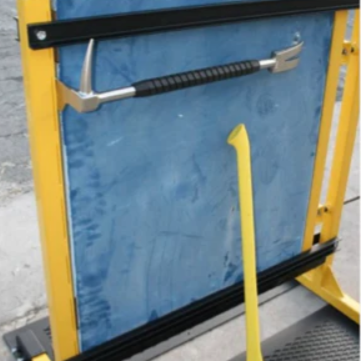
A reusable simulator can provide a controlled environment for practicing tool mechanics against resistance.
For training officers, the important issue is whether the simulator supports the intended learning objective.
If a drill is designed to develop effective use of leverage against a rigid assembly, instructors should choose a setup that provides meaningful resistance without encouraging unsafe or unrealistic techniques.
If the simulator cannot reproduce a particular type of frame movement or deformation, instructors should explain that limitation.
An effective training program may combine repeatable simulator evolutions with demonstrations using retired commercial door assemblies or other approved training materials.
This helps firefighters understand that proficiency on one simulator doesn't automatically translate to every steel door they will encounter.
Training Challenge #4: Understanding Commercial Door Security
A steel commercial door may resist entry because of its construction, but difficulty can also result from the hardware securing it.
Firefighters should become familiar with common commercial security arrangements and understand that multiple securing points may be present.
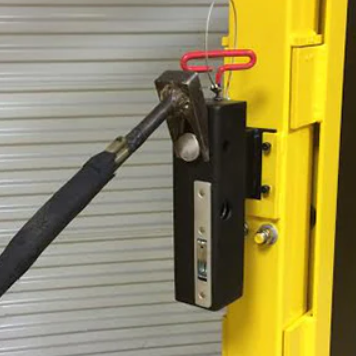
Examples include mortise locks, deadbolts, rim-mounted hardware, vertical securing mechanisms, and additional security devices.
Some commercial properties also use electronic access control.
These systems can behave differently depending on their design, power supply, and emergency release configuration.
The presence of electronic hardware should never be treated as a guarantee that a door will unlock during a fire.
Build hardware recognition into training
A useful instructional exercise is to present firefighters with examples of different commercial door hardware before they work on the training prop.
Instructors can explain what the visible hardware indicates and what remains unknown.
They can then ask firefighters to evaluate several door configurations and describe the considerations that would influence their entry plan.
This develops a different skill from simply forcing a door.
It helps firefighters recognize that commercial entry challenges are often the result of the complete security arrangement rather than the strength of the door material alone.
Training Challenge #5: Maintaining Door Control After Entry
Commercial steel doors can be heavy, self-closing, or equipped with hardware that affects how they move.
Some are fire-rated assemblies designed to help maintain compartmentation when closed.
That makes door control an essential part of forcible entry training.
Firefighters should not treat opening the door as the end of the evolution.
They need to consider what happens immediately afterward.
A door may open into an area with significant heat and smoke conditions. Opening that door can change airflow, potentially affecting fire behavior and interior conditions.
A heavy door may also require deliberate control to prevent unintended movement.
The appropriate action depends on the incident conditions and the entry team's operational objectives.
Make door control part of every evaluation
Training officers should establish clear expectations for what happens after a simulated door is forced.
That includes communication with the crew, recognition of conditions beyond the opening, and maintaining control of the door as required by the scenario.
Instructors should not automatically award a successful evolution simply because the prop opens.
A firefighter who uses sound tool mechanics but fails to coordinate the next stage of entry still has an important skill to develop.
This is especially relevant when training with steel doors, where the door assembly may behave differently from a lightweight residential door after opening.
What Forcible Entry Drills Help Prepare Firefighters for Steel Doors?
A useful commercial door training program should develop specific skills rather than relying on endless repetitions of the same evolution.
The following drills can be incorporated into a department's program according to instructor qualifications, equipment capabilities, and established safety procedures.
Drill 1: Commercial Door Construction Identification
Objective: Teach firefighters to distinguish between common commercial door assemblies.
Present several examples using photographs, retired doors, or actual building observations conducted with appropriate authorization.
Have firefighters identify the door material, frame construction, likely direction of swing, visible hardware, and factors that may affect entry.
The instructor should review the observations and explain where assumptions could be misleading.
This drill requires little physical exertion but builds the judgment needed before tools are deployed.
Drill 2: Tool Purchase and Mechanical Advantage
Objective: Evaluate how firefighters establish and maintain effective tool purchase against resistance.
Using an approved forcible entry simulator, instructors can observe tool positioning, body mechanics, and how firefighters respond to resistance.
The focus should be on controlled technique rather than completing the evolution as quickly as possible.
Instructors should identify when firefighters lose purchase, place tools incorrectly, or rely on unnecessary force.
If the simulator's behavior differs from actual commercial construction, that difference should be explained.
Drill 3: Recognizing Unproductive Door Deformation
Objective: Teach firefighters to recognize movement that doesn't represent useful progress.
Instructors can use a retired door assembly or other approved demonstration materials to illustrate how a metal door can deform while remaining secured.
Firefighters should be asked to interpret the mechanical response and explain why continuing the same approach may be ineffective.
The purpose isn't to destroy equipment unnecessarily. It is to develop recognition of the difference between visible damage and successful force application.
Drill 4: Commercial Door Size-Up Scenarios
Objective: Develop decision-making before tools are used.
Present firefighters with several commercial door scenarios.
One might involve an outward-swinging steel door in a masonry wall. Another could feature a hollow-metal door in a lighter framed wall. A third might include a door with visible supplemental security.
Before beginning an evolution, firefighters should describe the characteristics they observe, potential hazards, and the factors influencing their proposed approach.
Instructors can introduce additional information during the scenario to see whether firefighters adapt appropriately.
Drill 5: Coordinated Entry and Door Control
Objective: Integrate forcible entry with team communication and operational coordination.
Assign firefighters specific roles within an entry team.
The evolution should begin with the initial assessment and continue through the simulated opening and control of the door.
Instructors should observe how effectively firefighters communicate, coordinate tool work, recognize changing conditions, and transition to the next operational objective.
This type of training reinforces that forcible entry is part of a larger incident operation rather than an isolated physical task.
Should Firefighters Train on Actual Steel Doors or Commercial Door Props?
Ideally, a department's training program exposes firefighters to both controlled repetition and examples of actual door construction.
Each offers different advantages.
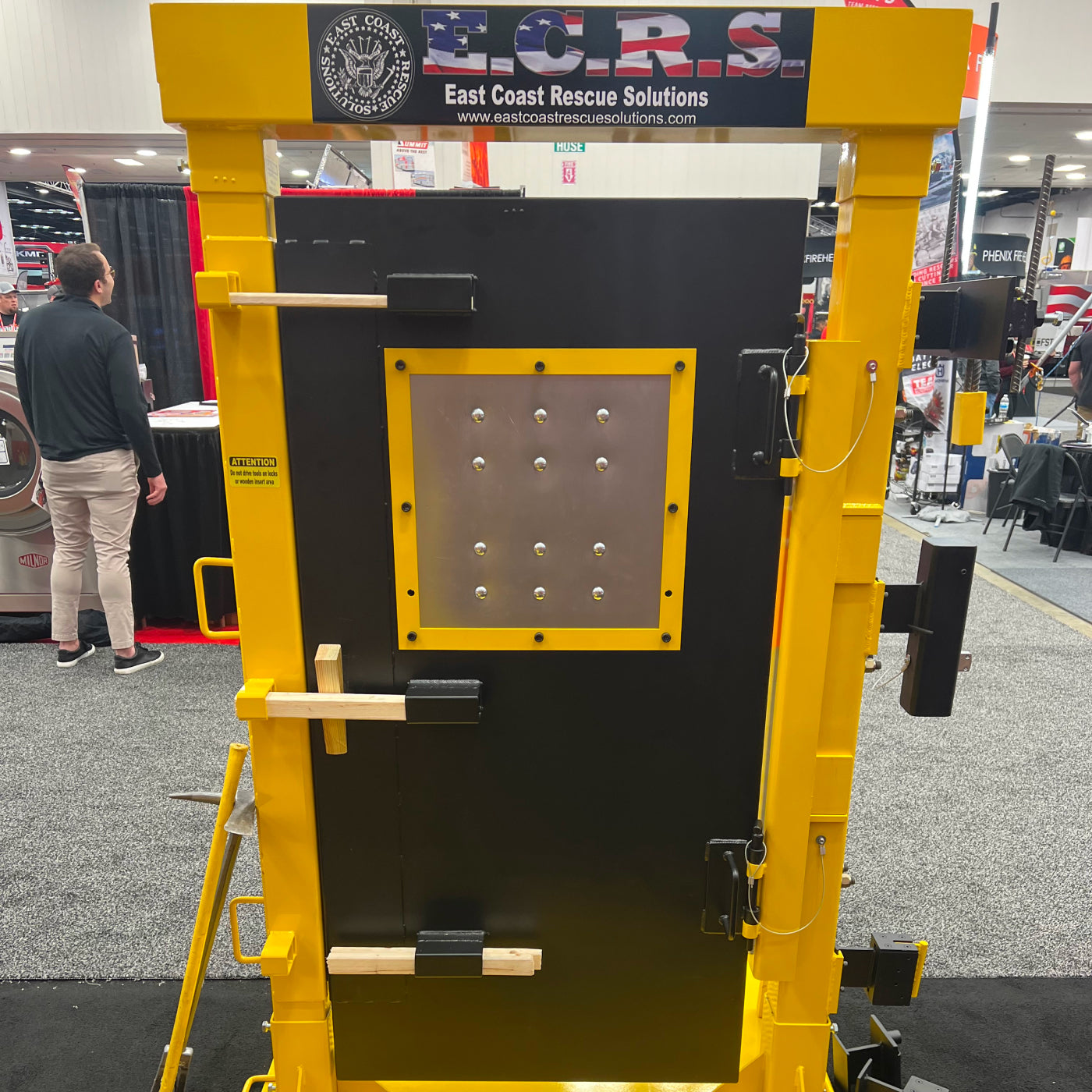
A commercial forcible entry prop allows firefighters to repeat fundamental movements in a consistent training environment.
Instructors can observe multiple attempts, identify deficiencies, and make corrections without necessarily rebuilding an entire door assembly after every evolution.
Actual steel doors and frames, meanwhile, can expose firefighters to construction details that may be difficult to reproduce in a reusable simulator.
These include the way metal skins deform, how hardware is installed, and how different frames respond to pressure.
However, using discarded doors requires appropriate facilities, secure installation, and qualified instructor oversight. A loose door or improperly anchored frame can create hazards and produce misleading training results.
The two approaches serve complementary purposes.
|
Training method |
Primary value |
Important limitation |
|---|---|---|
|
Commercial forcible entry simulator |
Consistent repetitions and instructor observation |
May not reproduce all forms of door deformation |
|
Retired steel door and frame |
Exposure to actual commercial construction |
Requires safe installation and may be consumed during training |
|
Hardware demonstration |
Understanding securing systems and construction |
Limited hands-on tool practice |
|
Building familiarization |
Recognizing doors encountered in the response district |
Does not provide permission for destructive training |
|
Scenario-based training |
Integrating decision-making and team coordination |
Requires planning and instructor oversight |
A department should select training methods based on the skills it needs to develop and the resources it can safely support.
What Should Departments Look for in a Commercial Forcible Entry Training Door?
For fire departments evaluating equipment, one of the most important considerations is whether the simulator supports realistic practice relevant to the doors found in their response areas.
A department protecting a large commercial district may have different training requirements from one primarily serving residential neighborhoods.
The training prop should support the department's objectives rather than dictate them.
Look beyond maximum resistance
A simulator that is difficult to force isn't necessarily more realistic.
Training officers should evaluate how resistance is created, what skills it supports, and whether firefighters can practice using effective mechanical advantage.
The equipment should help instructors identify problems with technique rather than simply challenge personnel to apply greater force.
Evaluate repeatability
Commercial door training requires consistent practice.
A simulator that can be used repeatedly gives instructors opportunities to observe the same firefighter across multiple evolutions and correct recurring mistakes.
Departments should ask manufacturers about reset procedures, replacement components, and expected maintenance.
Understand which door conditions it can simulate
Before purchasing, determine which entry configurations and training scenarios the simulator is designed to support.
Not every prop represents every type of door.
Training officers should ask for specific product demonstrations and written specifications rather than assume that a simulator can reproduce all commercial door arrangements.
Consider the larger training program
A training prop should support recruit development, continuing education, and scenario-based training where appropriate.
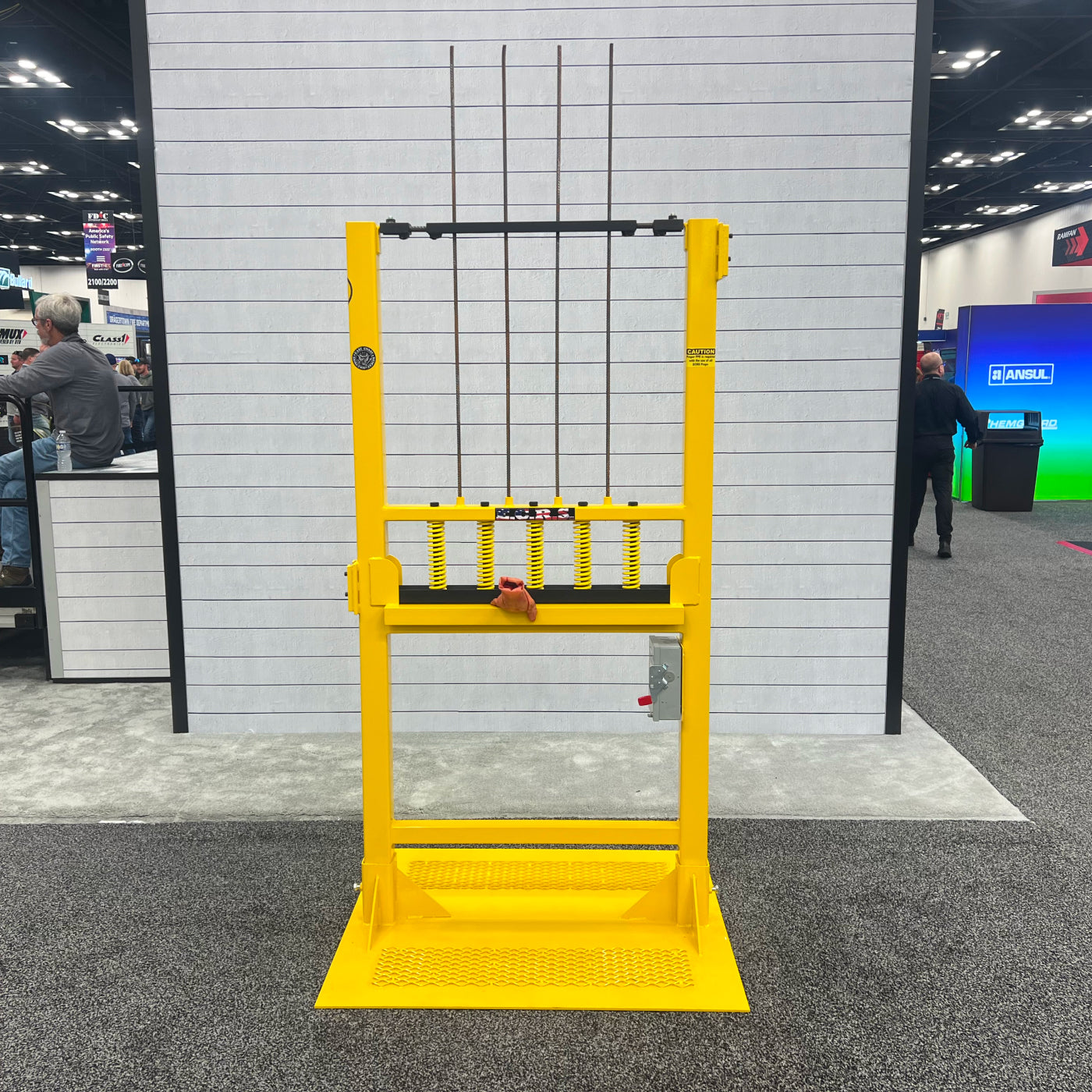
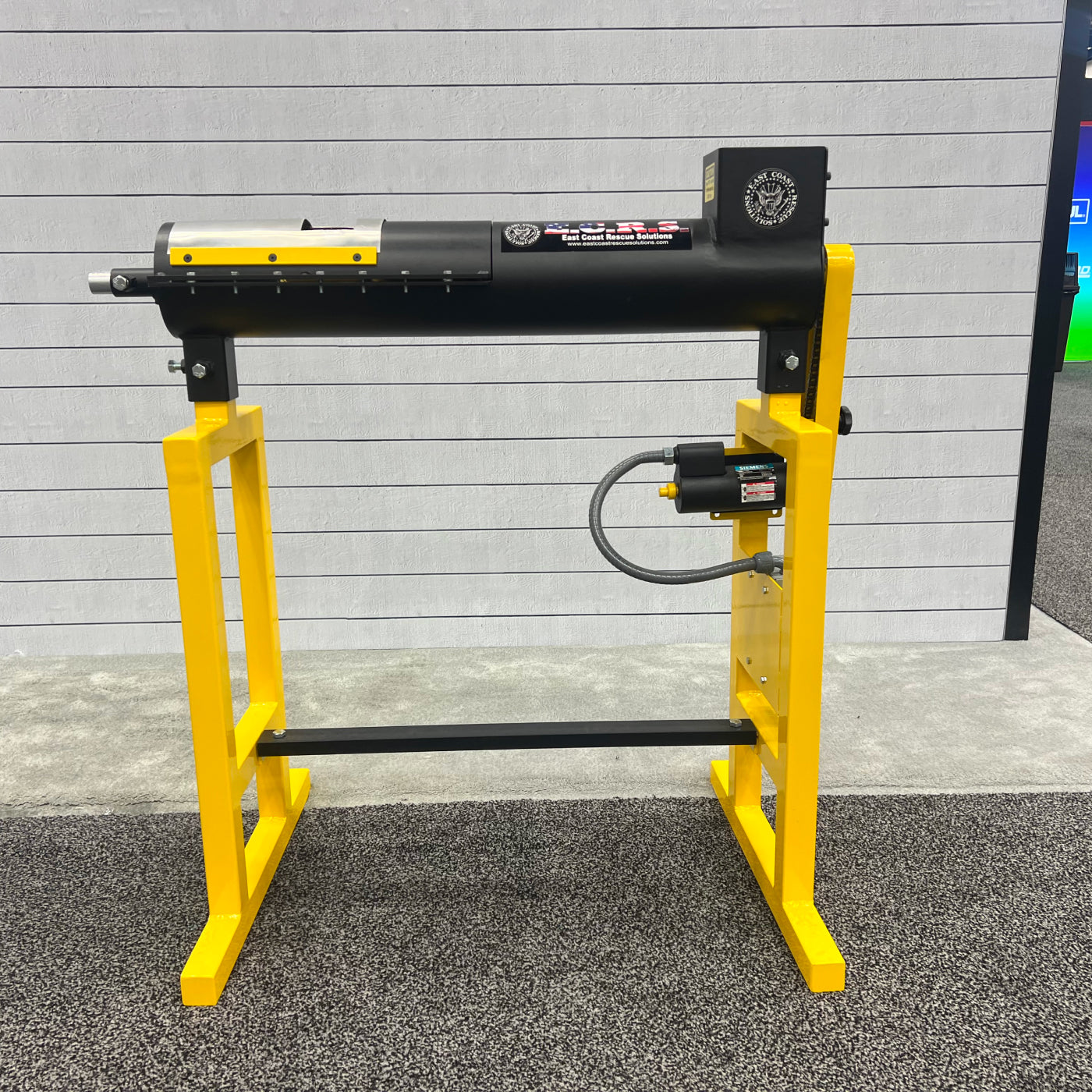
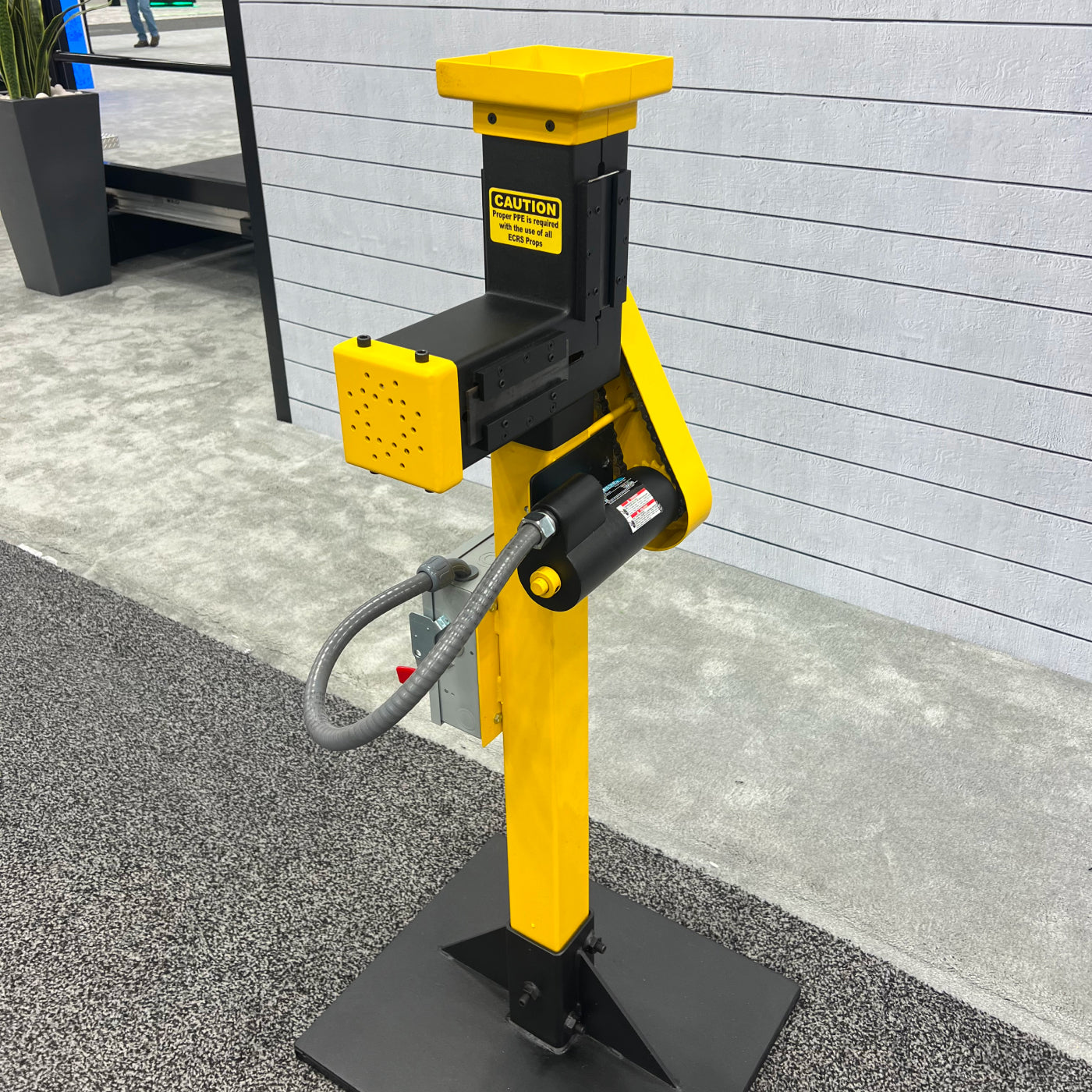
For departments looking to add hands-on practice, East Coast Rescue Solutions offers forcible entry door simulators that can be evaluated as part of a structured firefighter training program.
The most useful question isn't simply whether the simulator can be forced.
It's whether the equipment allows instructors to teach and evaluate the mechanical skills firefighters need when they encounter unfamiliar doors.
How Can Training Officers Evaluate Steel Door Forcible Entry Proficiency?
One problem with forcible entry training is that performance is often measured by a single outcome: whether the door opened.
That tells the instructor something, but not enough.
A firefighter may successfully complete an evolution using poor mechanics, overlooking door construction, or failing to maintain control after entry.
A more useful evaluation examines the entire process.
|
Skill area |
Questions for the instructor |
|---|---|
|
Size-up |
Did the firefighter identify door swing, construction, and visible security? |
|
Tool selection |
Was the selected equipment appropriate for the scenario? |
|
Mechanical understanding |
Did the firefighter recognize how the assembly responded to force? |
|
Tool control |
Was effective purchase maintained throughout the evolution? |
|
Adaptability |
Did the firefighter reassess when the original approach wasn't effective? |
|
Communication |
Did team members coordinate effectively? |
|
Door control |
Was the transition from forcing to entry handled appropriately? |
|
Safety |
Were departmental training procedures followed? |
This approach also makes it easier to identify individual training needs.
A firefighter who consistently struggles to recognize door construction may require different instruction from one who understands the assembly but has difficulty maintaining tool purchase.
Those problems shouldn't automatically be addressed by increasing the resistance of the simulator.
A Common Training Mistake: Treating Every Steel Door Like the Same Door
After repeated practice, firefighters may become highly proficient at defeating a particular training prop.
They understand its locking arrangement, how much resistance it provides, and exactly which movement will release it.
That proficiency is useful to a point.
But it can become a problem when firefighters begin assuming that all commercial doors behave similarly.
A steel door in a reinforced masonry opening is not the same as a hollow-metal door installed in a lightweight interior partition.
Likewise, two visually similar doors may have different securing systems and reinforcement.
A firefighter who relies entirely on familiarity with one simulator may struggle when those characteristics change.
The solution is not necessarily purchasing several different props.
Instead, instructors should introduce construction awareness, equipment limitations, and scenario variations into the training program.
They should also explain that techniques which consistently work on a reusable prop may produce different results against actual door assemblies.
The goal is to develop firefighters who can interpret an unfamiliar mechanical problem, not simply repeat a memorized sequence.
Why Building Familiarization Matters for Commercial Forcible Entry
One of the most valuable training resources available to a department may be the commercial buildings in its own response district.
With appropriate permission and coordination, firefighters can examine the different door assemblies encountered in local occupancies.
A department protecting warehouses may regularly encounter large commercial service doors and reinforced personnel entrances.
A department serving apartment buildings may find numerous steel stairwell doors and secured common-area entrances.
An industrial district may present specialized access arrangements that aren't commonly encountered elsewhere.
Training officers can document these features during building familiarization activities.
Photographs, notes about construction, and general observations about visible hardware can later support classroom instruction and scenario development.
Sensitive security details should be handled according to departmental policies rather than publicly distributed.
Connect building familiarization to hands-on training
For example, if crews repeatedly encounter a particular style of commercial metal frame in their response district, instructors can explain how its construction differs from the department's training simulator.
If local buildings commonly feature outward-swinging steel doors, the department should ensure firefighters understand the operational implications of that configuration.
Building familiarization helps training officers select relevant scenarios instead of relying entirely on generic training examples.
It also encourages firefighters to approach commercial doors as real building assemblies rather than standardized obstacles.
Final Thoughts: Train for the Construction, Not Just the Resistance
Steel doors and metal frames create challenges that firefighters may not experience during basic residential forcible entry training.
Rigid frames, varying locking arrangements, metal deformation, and unfamiliar construction can all affect how a door responds to force.
But those challenges cannot be solved simply by increasing the difficulty of a training prop.
Effective instruction begins with understanding door construction and recognizing how the entire assembly behaves.
Firefighters need to develop sound tool mechanics, maintain effective purchase, interpret the response of the door and frame, and recognize when their approach is not producing useful progress.
Training officers should combine repetitive hands-on practice with construction awareness, hardware recognition, building familiarization, and realistic scenarios.
Commercial forcible entry simulators can play an important role in that process, particularly when they allow instructors to observe and correct technique during repeated evolutions.
However, no single simulator should be treated as a perfect representation of every steel door.
The objective isn't to make firefighters strong enough to force a difficult training door. It's to develop firefighters who can assess unfamiliar steel door assemblies and apply the right skills when the situation demands it.
That's the difference between getting good at a training prop and developing genuine commercial forcible entry proficiency.