






Forcible entry is one of those firefighting skills that can appear straightforward in a controlled training environment but become considerably more difficult during an actual emergency. A firefighter may understand how to gap, set, and force a door, but performing those actions while wearing full PPE, communicating with a partner, working in poor visibility, and dealing with an unfamiliar door is a very different experience.
That is why effective forcible entry training should go beyond simply teaching firefighters how to use a Halligan and striking tool. Training should recreate as many of the variables firefighters are likely to encounter during an actual response as safely and practically as possible.
Realistic forcible entry training combines repeatable hands-on practice with different door configurations, realistic resistance, proper tools, full protective equipment, team communication, time pressure, and changing scenarios. The objective isn't simply to defeat a training door. It is to develop firefighters who can recognize the problem in front of them, select an appropriate technique, communicate effectively, and execute that technique under pressure.
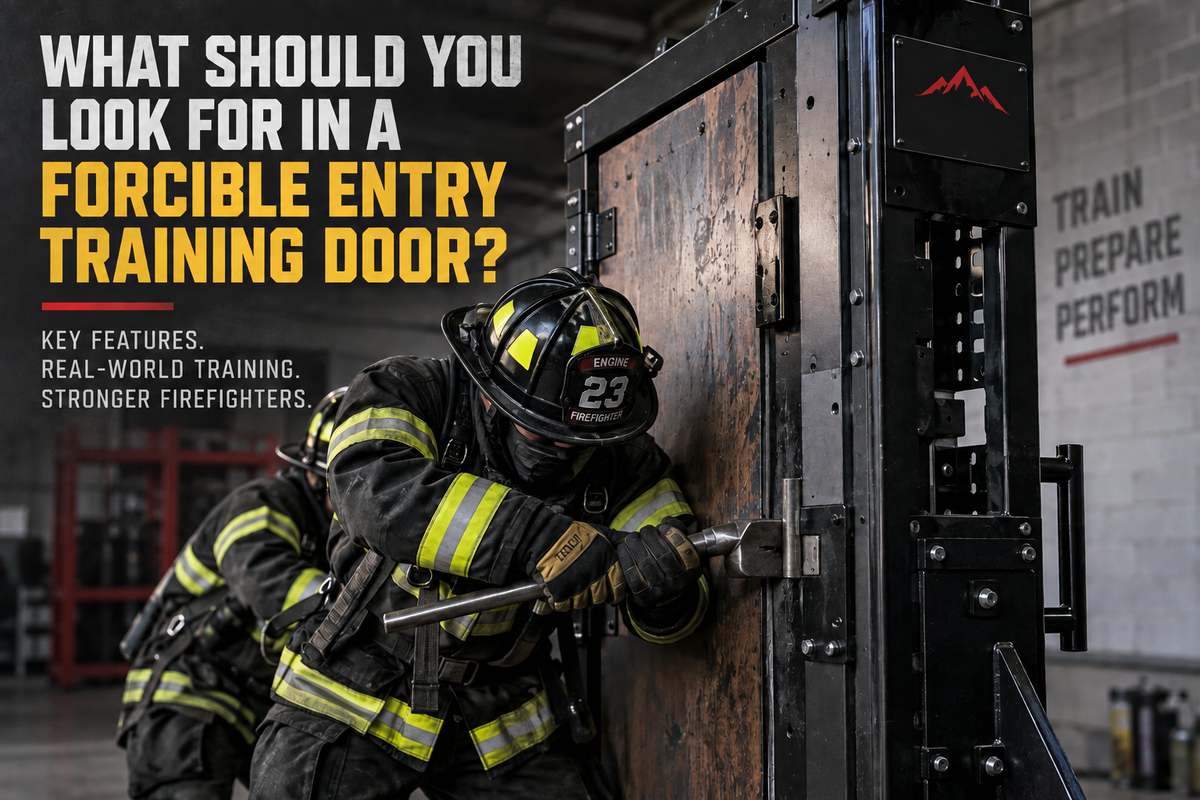
Start With a Realistic Forcible Entry Training Door
One of the most important components of realistic training is the door itself.
Practicing forcible entry against a prop that provides little resistance can help demonstrate basic tool positioning, but it does not fully prepare firefighters for the physical and mechanical challenges of forcing an actual door.
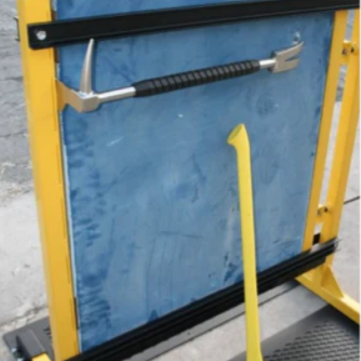
A good forcible entry training door should allow firefighters to practice the fundamental movements involved in conventional forcible entry while providing enough resistance to require proper technique.
Firefighters should have to establish a gap, position their tools correctly, communicate with the firefighter striking the Halligan, and apply force in a controlled manner.
Repeatability is also important.
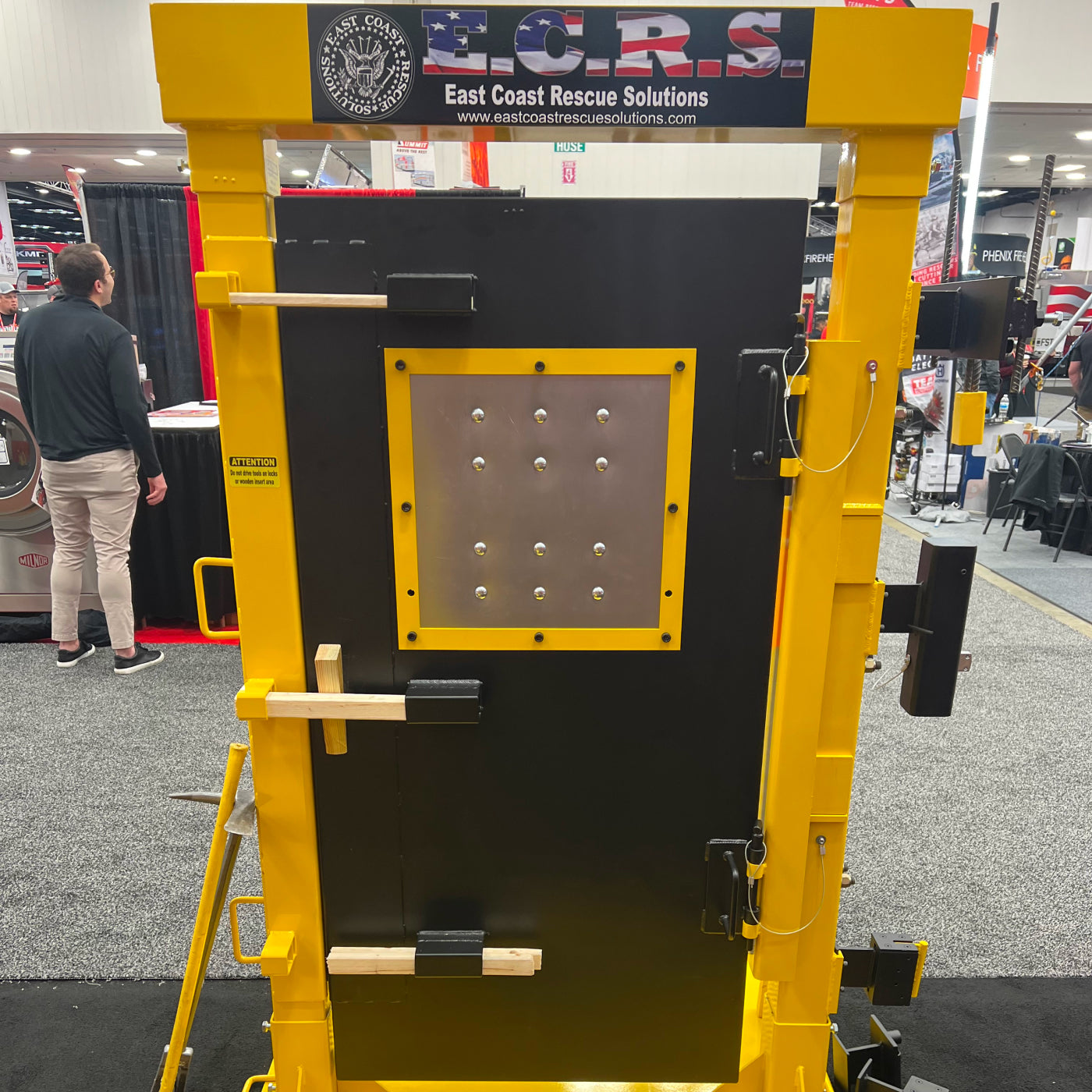
Training on an actual door may provide realism once, but after the door, frame, or locking hardware has been substantially damaged, reproducing the same scenario for the next firefighter becomes difficult. A purpose-built training prop can allow multiple firefighters to perform similar evolutions without replacing an entire door after each attempt.
For departments conducting regular forcible entry training, a reusable forcible entry door prop can make it easier to provide firefighters with repeated hands-on practice while maintaining a consistent training environment.
Train on Both Inward- and Outward-Opening Doors
Firefighters shouldn't become proficient at forcing only one type of door.
The orientation of the door changes the forcible entry problem.
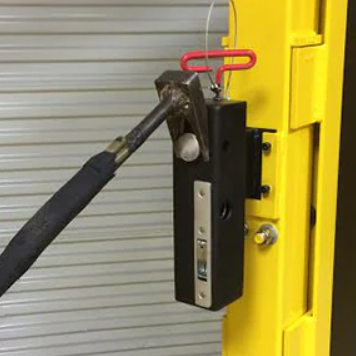
With an inward-opening door, firefighters commonly work to create a gap between the door and stop, set the Halligan, and force the door inward. Outward-opening doors present different considerations because of the door construction, hinges, locking hardware, and the limited access firefighters may have to the locking mechanism.
Firefighters need to learn how to size up the door before automatically reaching for a familiar technique.
Training should therefore expose crews to different door orientations and encourage them to identify what they see before beginning the evolution.
An instructor might ask:
Which direction does the door open?
Where are the hinges?
What type of locking mechanism is likely present?
Where should the Halligan be positioned?
Does conventional forcible entry make sense in this situation?
What could be happening on the opposite side of the door?
That turns the exercise from simply "force this door" into a decision-making exercise.
Create Different Levels of Resistance
Every door should not feel the same.
One of the shortcomings of repetitive prop training can occur when firefighters learn exactly how much force is required to defeat the prop. Eventually, they aren't necessarily reading the door anymore. They are remembering the prop.
Instructors can reduce this problem by changing the difficulty of the evolutions when the training system permits it.
A newer firefighter might begin with relatively light resistance so the instructor can focus on body position, tool placement, and communication.
As proficiency improves, the resistance can increase.
This forces firefighters to recognize when their initial technique isn't working and make adjustments rather than simply repeating the same motion.
The goal isn't to make every evolution unnecessarily difficult. The goal is to prevent firefighters from assuming that every forcible entry problem will respond exactly the same way.
Practice the Entire Gap-Set-Force Process
Realistic training should emphasize the process rather than simply whether the door eventually opens.
For conventional forcible entry, firefighters commonly learn the sequence of gap, set, and force.
Each stage deserves attention.
During the gap, firefighters work to create sufficient space for proper tool placement.
During the set, the Halligan must be driven into an effective position.
During the force, firefighters apply leverage to overcome the locking mechanism or resistance presented by the door.
Problems early in the process often affect everything that follows. Poor tool placement, inadequate depth, or ineffective communication can make the force considerably harder.
Instructors should therefore evaluate technique throughout the evolution rather than treating an open door as the only measure of success.
A firefighter who opens a training door through inefficient technique may still need considerable coaching.
Use the Tools Firefighters Will Actually Carry
Realism also depends on equipment.
Firefighters should become comfortable using the same types of tools they are likely to deploy during an incident.
For conventional forcible entry, that frequently means training with the irons—the Halligan paired with a striking tool such as a flat-head axe.
Training should include more than swinging the axe.
Firefighters need experience carrying the tools, positioning themselves at the door, controlling the Halligan, delivering controlled strikes, changing positions, and communicating with their partner.
This is particularly important because forcible entry is often a two-firefighter operation.
A firefighter may perform perfectly during an isolated Halligan drill yet struggle when another firefighter is swinging an axe only inches away. Repetition builds the coordination necessary for both firefighters to work safely and efficiently.
Train in Full PPE
Forcible entry feels different when performed in station clothing than it does in turnout gear.
Gloves reduce dexterity. A helmet can affect visibility and movement. An SCBA adds weight and changes a firefighter's balance and profile.
If firefighters only practice complicated forcible entry techniques without their normal protective equipment, they may develop habits that don't translate well to an emergency environment.
Once firefighters understand the basic technique, departments can incorporate appropriate PPE into training evolutions so crews become accustomed to manipulating tools and working around doors while equipped for operations.
Training conditions should always be selected and supervised according to the department's procedures, instructor judgment, and the specific exercise being performed.
Reduce Visibility
Real fires rarely provide perfect lighting and visibility.
Once firefighters have demonstrated proficiency in normal conditions, instructors can introduce controlled visibility challenges.
This does not mean immediately making every drill as difficult as possible. Complexity should be progressive.
A firefighter should first understand the mechanics of the technique. Once those fundamentals are established, instructors can make the environment more challenging.
Reduced visibility forces firefighters to rely more heavily on tactile feedback, communication, and their understanding of the door and tools.
It also exposes weaknesses that may not be obvious during a brightly lit training evolution.
Incorporate Realistic Communication
Forcible entry is not just a tool skill. It is a communication skill.
The firefighter controlling the Halligan and the firefighter operating the striking tool must coordinate their actions closely.
The Halligan firefighter needs to communicate when the tool is properly positioned and when additional strikes are necessary. The striking firefighter must understand those commands and deliver controlled, accurate blows.
This coordination becomes increasingly important as noise and stress increase.
Training should therefore require firefighters to communicate throughout the evolution rather than allowing two firefighters who know the drill to silently go through the motions.
Clear communication should become part of the technique itself.
Add Time Pressure Carefully
Time matters during an emergency, but a stopwatch should not be the first thing introduced during forcible entry training.
Speed should come after proficiency.
If instructors emphasize speed too early, firefighters may rush their size-up, sacrifice tool placement, or rely on brute force instead of good technique.
A better progression is:
Learn the technique.
Develop consistency.
Introduce additional resistance.
Add equipment and environmental challenges.
Then introduce controlled time pressure.
Once firefighters are proficient, timed evolutions can help introduce stress and reveal how well those skills hold up when crews feel pressure to gain access quickly.
The objective isn't to create a competition over who can swing the hardest. It is to determine whether firefighters can continue making good decisions and using proper technique when speed matters.
Incorporate Door Control Into the Evolution
Opening the door isn't necessarily the end of the forcible entry problem.
Once access has been gained, firefighters may need to maintain control of that opening.
Uncontrolled door movement can affect conditions inside a structure by changing airflow. It can also create operational problems for crews working around the entry point.
Training should therefore continue beyond the moment the locking resistance is defeated.
Firefighters should understand what happens next.
Who controls the door?
When should it be opened?
When might it need to remain controlled?
How does the entry team's objective affect what happens after the force?
This is also why forcible entry and door control should be trained together rather than treated as completely unrelated skills.
Use Scenario-Based Training Instead of Identical Repetitions
Repetition is necessary, but predictable repetition has limitations.
If every evolution begins with an instructor saying, "Force this inward-opening door using the irons," firefighters don't have to make many decisions.
Instead, instructors can provide a scenario.
For example, a crew might be told that they have arrived at a reported residential structure fire with occupants possibly trapped. Their assigned entry point is a secured door.
Now the firefighters must approach the problem more like an actual incident.
They have to size up the door, identify its orientation, select tools, communicate responsibilities, perform the force, control the opening, and prepare for the next operational objective.
Other scenarios can change the building type, door configuration, available tools, staffing, or assignment.
The physical skill may remain similar, but the firefighter must continually reassess the situation.
Introduce Problems Firefighters Have to Solve
Some of the best training occurs when the first technique doesn't work perfectly.
Real forcible entry problems don't always cooperate.
A Halligan may not initially be positioned correctly. A door may provide more resistance than expected. The firefighter may discover something during the force that changes the size-up.
Instructors can use training to develop adaptability.
Instead of immediately telling the firefighter what to do, the instructor can ask:
What is preventing you from making progress?
Can you improve the gap?
Is your tool properly positioned?
Could changing your body position improve leverage?
Do you need to change techniques?
This teaches firefighters to diagnose a forcible entry problem rather than simply memorize a sequence of movements.
Rotate Firefighters Through Different Roles
Realistic training should also prevent firefighters from becoming comfortable with only one role.
During two-person conventional forcible entry, firefighters can rotate between operating the Halligan and operating the striking tool.
Company officers and instructors can also observe how different firefighter pairings perform together.
A crew that practices together repeatedly can develop more efficient communication and coordination, but firefighters should still be capable of working effectively with different members of the department.
Rotating assignments provides broader experience and helps instructors identify individual weaknesses.
Don't Confuse Difficulty With Realism
Making training harder does not automatically make it better.
An unrealistically difficult prop may actually encourage bad habits if firefighters discover that excessive force is the only way to complete the evolution.
Likewise, adding darkness, noise, time pressure, heavy resistance, and complicated scenarios all at once may overwhelm inexperienced firefighters without improving their understanding.
Realistic training should be progressive.
Start with fundamentals. Develop correct technique. Increase resistance. Introduce equipment and environmental factors. Add decision-making. Then combine those elements into more complex scenarios.
This allows firefighters to build competence before being asked to perform under increasingly challenging conditions.
Repetition Is What Turns Technique Into Capability
One of the greatest advantages of a dedicated training prop is the ability to repeat an evolution.
Watching forcible entry demonstrations is useful. Performing the technique once is better. Performing it repeatedly under changing conditions is where firefighters begin developing genuine proficiency.
Repeated practice allows firefighters to experiment with body position, understand how tool placement affects leverage, improve striking accuracy, recognize resistance, and communicate more efficiently with a partner.
It also allows instructors to correct small problems before they become established habits.
A firefighter should not simply remember what forcible entry is supposed to look like. The firefighter should have enough hands-on experience to recognize what correct technique feels like.
Realistic Forcible Entry Training Builds Better Decision-Makers
Ultimately, realistic forcible entry training isn't about creating a prop that perfectly duplicates every door a firefighter could encounter. That would be impossible.
The real objective is to combine realistic physical resistance with enough variation and decision-making that firefighters cannot simply memorize the exercise.
A strong training program teaches firefighters to size up the door, understand how it operates, select an appropriate technique, position their tools correctly, communicate with their partner, recognize when something isn't working, and adjust accordingly.
Equipment such as a reusable forcible entry training door can provide the foundation for that practice, but the instructor determines how realistic the training becomes.
When departments combine quality training props with full PPE, appropriate tools, changing resistance, different door configurations, communication, door control, problem-solving, and progressive scenarios, forcible entry training becomes much more than an exercise in opening a door.
It becomes practice in solving forcible entry problems under realistic conditions.